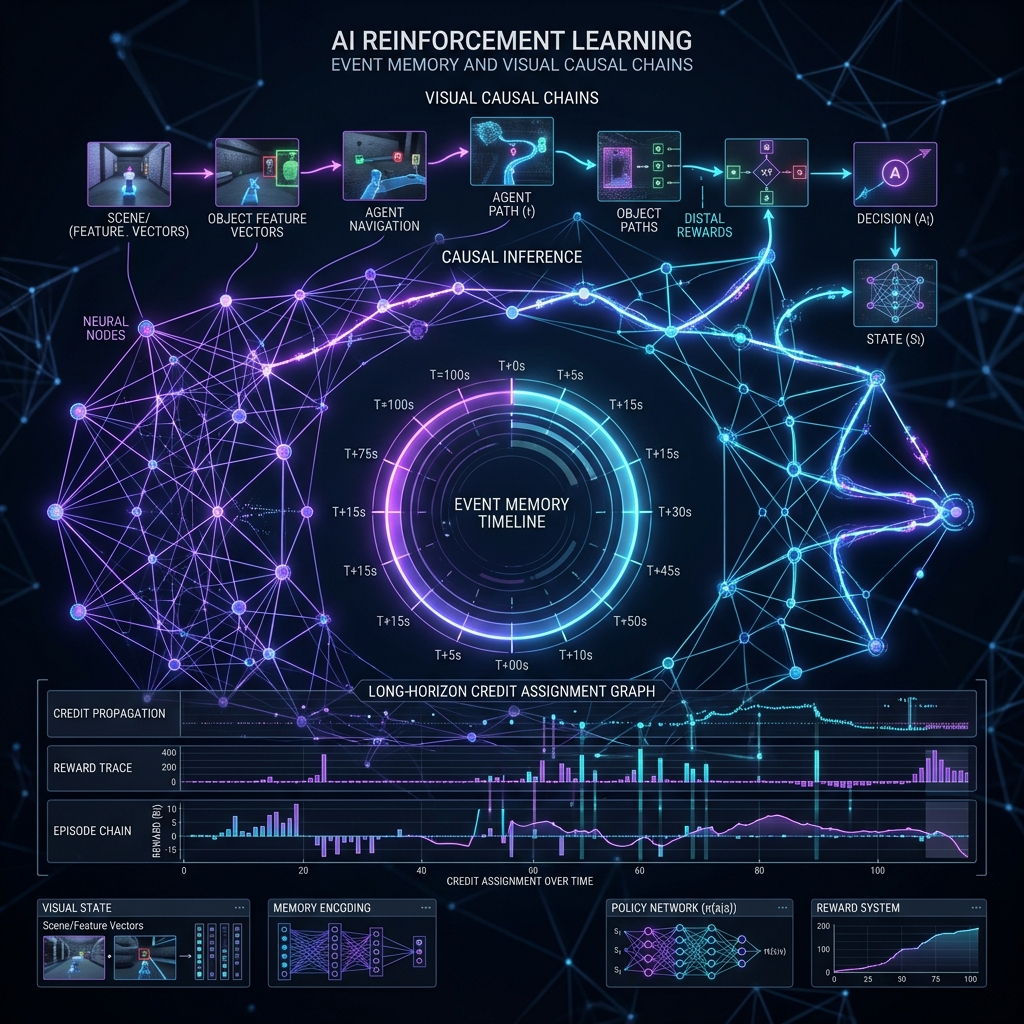
Visual Causal-chain Bookmarking
[MSc Dissertation] Retrieval-weighted credit assignment for reinforcement learning from delayed reward. VCBM concentrates learning signal on the causally relevant decision points in a trajectory instead of spreading it uniformly, via two instantiations: statistical causal discovery with Welford value estimation in a tabular MDP (beating a RUDDER return-redistribution baseline — 95.07% correct-decision rate in a mean of 1,532 vs. RUDDER's 3,327 episodes across 20 seeds), and retrieval-weighted advantage blending for an LLM agent trained with LOOP inside the AppWorld benchmark.
Key Features
Core technologies and system features.
Causal Bookmark Detection
Automatically identifies causally significant steps via HTTP state-change events (POST/PUT/DELETE/PATCH with status < 400). Mathematically equivalent to full environment state-diff detection under REST semantics — zero accuracy loss.
VCC Credit Redistribution
Loss weighting: L_VCC = -(Σ_{t∈B} L_t^PPO + α·Σ_{t∉B} L_t^PPO) / (|B| + α(T−|B|)). Setting α=1 recovers standard LOOP exactly. α=0.1 used in experiments. Implemented on top of Apple ML Research's LOOP framework with Qwen2.5-1.5B-Instruct + LoRA rank-8.
AppWorld Benchmark
Evaluated on AppWorld (ACL 2024) — a multi-app digital assistant benchmark with 750+ tasks across Spotify, Gmail, Calendar and 10+ APIs. Agent generates Python code to interact with a sandboxed app environment. Tasks require 5–20+ API calls with sparse rewards.
Hardware & Scale
Training on NVIDIA RTX 4080 (15.57 GiB VRAM), 1.55B parameter model (Qwen2.5-1.5B-Instruct), LoRA fine-tuning (9.23M trainable params, 0.59%). vLLM V1 inference engine, FSDP2 single-GPU training. 100-iteration VCBM run completed; scaling to 3.5B on UoM CSF cluster (ticket RITM0104892 approved).
Timing Breakthrough
Root cause analysis revealed rollout collection accounts for 98% of VCBM's overhead vs LOOP (1500s vs 88s per 50 steps). Fix 1 — HTTP bookmark detector added inline to execute_with_bookmark() — projects to reduce get_rollouts from 1500s → ~75–100s, making VCBM ~8% faster than LOOP overall.
Performance Graphs
Visualisations of model performance and results across experiments.
Training on the University of Manchester CSF3 cluster — 2x RTX A800 (80 GB VRAM each)
AppWorld · single seed · VCBM ≈ estimate
ML-LOOP vs VCBM — AppWorld 7B Results
Project Source Code
Explore the primary logical modules.
1from pathlib import Path234def patch_server():5 filepath = "appworld-env/lib/python3.12/site-packages/appworld/serve/environment.py"6 if not Path(filepath).exists():7 print(f"Error: {filepath} not found. Please make sure appworld-env is set up.")8 return False910 with open(filepath) as f:11 content = f.read()1213 if "execute_with_bookmark" in content:14 print("Server is already patched.")15 return True1617 execute_marker = '@app.post("/execute")'18 idx = content.find(execute_marker)19 if idx == -1:20 print("Error: Could not find @app.post('/execute') route in environment.py")21 return False2223 end_marker = 'return {"output": output}'24 end_idx = content.find(end_marker, idx)25 if end_idx == -1:26 print("Error: Could not find the end of execute function in environment.py")27 return False2829 end_of_func = end_idx + len(end_marker)3031 new_endpoint = """3233@app.post("/execute_with_bookmark")34async def execute_with_bookmark(task_id: str = Body(...), code: str = Body(...)) -> dict[str, Any]:35 maybe_raise_exception(task_id)36 n_requests_before = len(world.requester.request_tracker.requests)37 output = world.execute(code)38 new_requests = world.requester.request_tracker.requests[n_requests_before:]39 is_bookmark = False40 if "Execution failed." not in output:41 is_bookmark = any(42 req.get("method", "").upper() in ("POST", "PUT", "DELETE", "PATCH")43 for req in new_requests44 )45 return {"output": {"output": output, "is_bookmark": is_bookmark}}"""4647 patched_content = content[:end_of_func] + new_endpoint + content[end_of_func:]4849 with open(filepath, "w") as f:50 f.write(patched_content)5152 print("Successfully patched AppWorld server environment.py!")53 return True545556if __name__ == "__main__":57 patch_server()Live Simulation Output
Simulated console execution.
Source Code
GitHub repositories for this project.