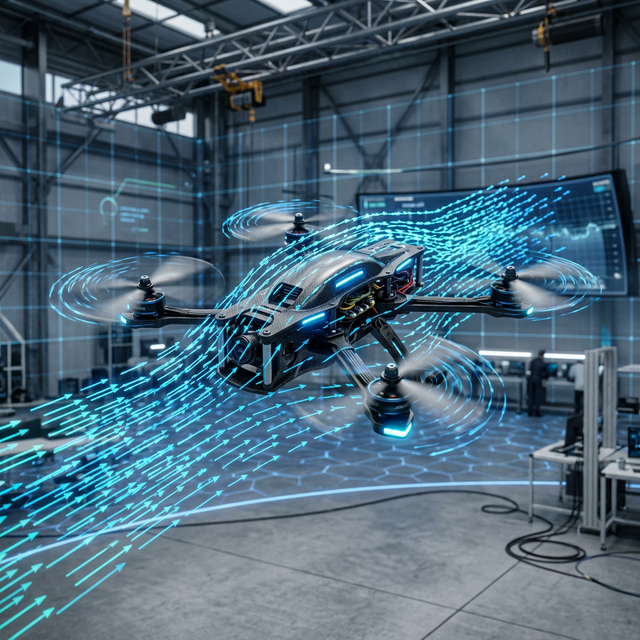
Drone Feedback Controller
Adaptive Q-learning reinforcement learning agent with a nested PID actuation layer for UAV position stabilisation and waypoint navigation.
Key Features
Core technologies and system features.
Q-Learning Adaptation
Online tabular RL agent that selects optimal PID gains based on real-time flight states.
Nested PID Control
High-frequency PID actuation layer (1000Hz) for precise velocity and attitude tracking.
Wind Disturbance Handling
Adaptive integral clamping and gain scheduling specifically tuned for robust performance in windy environments.
Experience Replay
Stabilises learning using a 400-sample circular buffer for off-policy TD(0) updates.
Source
Explore the primary logical modules.
1# =============================================================================2# MATHEMATICAL HELPERS3# =============================================================================45def _clip(v, lo, hi):6 """Saturate value v to the closed interval [lo, hi]. Used for anti-windup and velocity caps."""7 return max(lo, min(hi, v))8910def _state_key(dist, abs_yaw_err, wind):11 """12 Discretise the continuous (distance, yaw_error, wind) state into a hashable13 tuple that indexes the Q-table.1415 Naming convention:16 dist – 3-D Euclidean distance to target (m).17 abs_yaw_err – absolute yaw error (rad); always non-negative.18 wind – bool converted to int (False→0, True→1).1920 Returns (dist_band, yaw_band, wind_int) – all integers.21 96 total states: 8 dist_band × 6 yaw_band × 2 wind_int.22 Ref: Lecture 10 – state discretisation for tabular RL.23 """24 # dist_band: finer resolution close to target where precision matters.25 if dist < 0.08: dist_band = 026 elif dist < 0.20: dist_band = 127 elif dist < 0.40: dist_band = 228 elif dist < 0.70: dist_band = 329 elif dist < 1.10: dist_band = 430 elif dist < 1.80: dist_band = 531 elif dist < 2.80: dist_band = 632 else: dist_band = 73334 # yaw_band: finer resolution near zero (aligned).35 if abs_yaw_err < 0.04: yaw_band = 036 elif abs_yaw_err < 0.10: yaw_band = 137 elif abs_yaw_err < 0.25: yaw_band = 238 elif abs_yaw_err < 0.50: yaw_band = 339 elif abs_yaw_err < 1.00: yaw_band = 440 else: yaw_band = 54142 wind_int = int(wind) # False→0, True→1.43 return (dist_band, yaw_band, wind_int)444546# =============================================================================47# CSV WAYPOINT LOADER48# =============================================================================49def _load_csv_targets(csv_path=None):50 """51 Loads a sequence of target waypoints from a CSV file.52 Provides a default square pattern if the file is missing or invalid.53 54 Args:55 csv_path (str): Path to the CSV file containing target coordinates.56 If None, defaults to 'targets.csv' in the same directory as this file.57 58 Returns:59 tuple: A tuple of target tuples: ((x1, y1, z1, yaw1), (x2, y2, z2, yaw2), ...)60 """61 if csv_path is None:62 csv_path = os.path.join(os.path.dirname(os.path.abspath(__file__)), "targets.csv")63 # Default fallback flight pattern (a simple 2x2 square at 2m altitude)64 _DEFAULTS = (65 ( 2.0, 2.0, 2.0, 0.0),66 (-2.0, 2.0, 2.0, 1.57),67 (-2.0, -2.0, 2.0, 3.14),68 ( 2.0, -2.0, 2.0, 4.71),69 )7071 if not os.path.isfile(csv_path):72 return _DEFAULTS7374 try:75 targets = []76 with open(csv_path, newline="") as fh:77 reader = csv.DictReader(fh)78 fields = [f.strip() for f in (reader.fieldnames or [])]7980 def _col(axis):81 for c in (f"target_{axis}", axis):82 if c in fields:83 return c84 raise ValueError(f"No '{axis}' column in {fields}")8586 cx, cy, cz = _col("x"), _col("y"), _col("z")87 cyaw = next(88 (c for c in ("target_yaw", "yaw", "heading", "psi") if c in fields),89 None,90 )91 if cyaw is None:92 raise ValueError("No yaw column found")9394 for i, raw in enumerate(reader):95 row = {k.strip(): v.strip() for k, v in raw.items()}96 try:97 targets.append((float(row[cx]), float(row[cy]),98 float(row[cz]), float(row[cyaw])))99 except (KeyError, ValueError) as e:100 raise ValueError(f"Bad row {i+2}: {row}") from e101102 return tuple(targets) if targets else _DEFAULTS103 except Exception:104 return _DEFAULTS105106107_CSV_TARGETS = _load_csv_targets()108109110# =============================================================================111# RL AGENT FUNCTIONS112# =============================================================================113114def _get_errors(state, active_target):115 """116 [ADVANCED METHOD – State Estimator & Coordinate Frame Transformation]117118 Computes all tracking errors needed by the PID controller and the RL cost.119120 NAMING CONVENTION used throughout this function and all callers:121 ex_w, ey_w – position errors in the World (inertial) frame (m).122 ex_b, ey_b – position errors in the Body frame (m), after R_z(yaw).123 ez – altitude error; identical in both frames for level flight.124 eyaw – yaw error wrapped to (-π, π] (rad).125 dist – 3-D Euclidean distance to target (m).126 cost – scalar RL cost used to compute reward signal.127128 WHY WORLD AND BODY FRAME ERRORS?129 PID integration and differentiation use world-frame errors (ex_w, ey_w)130 to avoid false spikes when the drone yaws. Body-frame errors (ex_b, ey_b)131 are stored in the return dict for reference but the main PID uses world frame.132 The final velocity commands are rotated back to body frame in controller()133 Step 8 before being returned to run.py.134 Ref: Lecture 6, p.14 – R_z(ψ) rotation matrix.135136 ROTATION MATRIX (yaw only):137 [ ex_b ] [ cos(yaw) sin(yaw) ] [ ex_w ]138 [ ey_b ] = [-sin(yaw) cos(yaw) ] [ ey_w ]139140 COST FUNCTION:141 cost = dist² + 0.60·eyaw² + prec142 prec = 5·max(0, 0.10 − dist)² (precision bonus for sub-10 cm accuracy)143 Ref: Lecture 10, p.15 – reward shaping.144 """145 x, y, z, _, _, yaw = (float(v) for v in state)146 tx, ty, tz, tyaw = (float(v) for v in active_target)147148 # World-frame position errors.149 ex_w = tx - x150 ey_w = ty - y151 ez = tz - z152153 # Yaw error wrapped to (-π, π]. Ref: Lecture 6, p.11 – angle wrapping.154 eyaw = math.atan2(math.sin(tyaw - yaw), math.cos(tyaw - yaw))155156 # Body-frame XY errors via 2×2 yaw rotation matrix.157 cos_yaw, sin_yaw = math.cos(yaw), math.sin(yaw)158 ex_b = cos_yaw * ex_w + sin_yaw * ey_w159 ey_b = -sin_yaw * ex_w + cos_yaw * ey_w160161 # RL cost function.162 dist = math.sqrt(ex_w**2 + ey_w**2 + ez**2)163 prec = 5.0 * max(0.0, 0.10 - dist) ** 2164 cost = dist**2 + 0.60 * eyaw**2 + prec165166 # All keys use the naming convention documented above.167 return {168 "dist": dist, "cost": cost,169 "eyaw": eyaw, "ez": ez,170 "ex_w": ex_w, "ey_w": ey_w, # World-frame: used by PID integral/derivative.171 "ex_b": ex_b, "ey_b": ey_b, # Body-frame: stored for reference.172 }173174175def _td_update(mem, state_key, action_idx, reward, next_state_key):176 """177 [ADVANCED METHOD – Q-learning Temporal Difference Update]178179 Naming convention for parameters:180 state_key – hashable tuple (dist_band, yaw_band, wind_int) for current state.181 action_idx – integer 0-15 index of the action taken.182 reward – scalar reward received after the action.183 next_state_key – hashable tuple for the resulting next state.184 q_curr – Q-value list for the current state (16 entries).185 q_next – Q-value list for the next state (16 entries).186187 UPDATE RULE (Ref: Lecture 10, p.19):188 Q(state_key, action_idx) +=189 alpha × [ reward + gamma × max(q_next) − Q(state_key, action_idx) ]190 """191 q_curr = mem["q_table"].setdefault(state_key, [0.0] * len(_ACTION_PROFILES))192 q_next = mem["q_table"].setdefault(next_state_key, [0.0] * len(_ACTION_PROFILES))193 q_curr[action_idx] += mem["alpha"] * (194 reward + mem["gamma"] * max(q_next) - q_curr[action_idx]195 )196197198def _replay_update(mem):199 """200 [ADVANCED METHOD – Experience Replay Mini-Batch Update]201202 Samples mem["replay_batch"] past transitions from the replay buffer and203 applies _td_update to each, using the same parameter naming convention:204 state_key, action_idx, reward, next_state_key.205 Ref: Lecture 10, p.21 – experience replay.206 """207 if len(mem["replay"]) < mem["replay_batch"]:208 return209 for state_key, action_idx, reward, next_state_key in \210 mem["rng"].sample(mem["replay"], mem["replay_batch"]):211 _td_update(mem, state_key, action_idx, reward, next_state_key)212213214def _update_learning_agent(mem, errs, dwell_bonus, state_key):215 """216 [ADVANCED METHOD – Online Q-learning with Reward Shaping]217218 Naming convention:219 errs – error dict from _get_errors (keys: dist, cost, eyaw, etc.).220 dwell_bonus – float bonus from _handle_dwell (0.0 if not within tolerance).221 state_key – current discretised state (dist_band, yaw_band, wind_int).222 reward – total shaped reward for the PREVIOUS action.223 overshoot_penalty – penalty when close but cost is increasing (drone overshooting).224225 All reward weight values come from _REWARD_WEIGHTS for full transparency.226 Update is throttled to every 5th step to save CPU for pybullet physics server.227 Ref: Lecture 10, p.18-21 – reward shaping, TD(0), experience replay.228 """229 if mem["prev_key"] is None:230 return # No previous transition on the very first call.231232 # Overshoot penalty: cost increase when close means the drone is moving away.233 overshoot_penalty = (234 _REWARD_WEIGHTS["overshoot"] * (errs["cost"] - mem["prev_cost"])235 if (errs["dist"] < 0.6 and errs["cost"] > mem["prev_cost"])236 else 0.0237 )238239 reward = (240 (mem["prev_cost"] - errs["cost"]) # Cost improvement.241 + dwell_bonus # Arrival/hold bonus.242 - _REWARD_WEIGHTS["effort"] * mem["prev_effort"] # Effort penalty.243 - _REWARD_WEIGHTS["distance"] * errs["dist"] ** 2 # Distance penalty.244 - overshoot_penalty # Overshoot penalty.245 )246247 if mem["step_count"] % 5 == 0:248 _td_update(mem, mem["prev_key"], mem["prev_action"], reward, state_key)249 mem["replay"].append((mem["prev_key"], mem["prev_action"], reward, state_key))250 if len(mem["replay"]) > mem["replay_cap"]:251 mem["replay"].pop(0)252 _replay_update(mem)253254 mem["epsilon"] = max(mem["eps_floor"], mem["epsilon"] * mem["eps_decay"])255256257def _handle_dwell(mem, errs, target_pos):258 """259 Manage the dwell-hold phase: count consecutive in-tolerance steps, award RL260 bonuses, reset integrators, and advance the waypoint index in free-fly mode.261262 Naming convention:263 target_pos – the raw argument from controller() (None in free-fly mode).264 Named identically to the controller() parameter to make the265 pass-through explicit: controller receives target_pos from266 run.py and passes it here unchanged.267 dwell_bonus – float returned to controller() and forwarded to268 _update_learning_agent() as dwell_bonus.269 is_within – bool: True if BOTH dist and yaw are inside tolerance.270271 Ref: Coursework spec – 10 s stabilisation window; Lecture 10, p.16.272 """273 is_within = errs["dist"] < _POS_TOL and abs(errs["eyaw"]) < _YAW_TOL274 dwell_bonus = 0.0275276 if is_within:277 mem["dwell_steps"] += 1278 if mem["dwell_steps"] == 1:279 dwell_bonus = _REWARD_WEIGHTS["dwell_enter"]280 elif mem["dwell_steps"] >= _HOLD_STEPS:281 dwell_bonus = _REWARD_WEIGHTS["dwell_complete"]282 mem["dwell_steps"] = 0283 mem["integral"] = [0.0, 0.0, 0.0]284 mem["integral_yaw"] = 0.0285 if target_pos is None:286 mem["wp_idx"] = (mem["wp_idx"] + 1) % len(_CSV_TARGETS)287 else:288 mem["dwell_steps"] = 0289290 return dwell_bonus291292293def _choose_action(mem, state_key, force_exploit=False, mask_coarse=False, mask_fine=False):294 """295 [ADVANCED METHOD – ε-greedy Policy with Bi-directional Safety Masking]296297 Naming convention:298 state_key – current Q-table lookup key (dist_band, yaw_band, wind_int).299 q_vals – raw Q-values for state_key from the Q-table (list of 16 floats).300 q_masked – Q-values after safety masking (-1e9 for forbidden actions).301 action_idx – integer 0-15 index of the selected action profile.302 eps – effective epsilon (0.0 if force_exploit, else mem["epsilon"]).303 best_q – maximum value in q_masked (used for greedy selection).304 tied_actions – list of action indices that all share best_q (tie-breaking).305306 SAFETY MASKING (Ref: Lecture 10, p.22):307 mask_coarse (dist < 0.1 m): blocks profiles 0-3 (high-speed).308 mask_fine (dist > 1.5 m): blocks profiles 8-15 (slow hover).309 Forbidden entries set to -1e9 so argmax never selects them.310 """311 q_vals = mem["q_table"].setdefault(state_key, [0.0] * len(_ACTION_PROFILES))312313 if mask_coarse:314 q_masked = [v if i >= 4 else -1e9 for i, v in enumerate(q_vals)]315 elif mask_fine:316 q_masked = [v if i < 8 else -1e9 for i, v in enumerate(q_vals)]317 else:318 q_masked = q_vals319320 eps = 0.0 if force_exploit else mem["epsilon"]321322 if mem["rng"].random() < eps:323 if mask_coarse: return mem["rng"].randrange(4, 16)324 if mask_fine: return mem["rng"].randrange(0, 8)325 return mem["rng"].randrange(0, 16)326327 best_q = max(q_masked)328 tied_actions = [i for i, v in enumerate(q_masked) if v == best_q]329 action_idx = tied_actions[mem["rng"].randrange(len(tied_actions))]330 return action_idx331332333def _init_memory():334 """335 Initialise the persistent state dictionary stored as controller._mem.336337 Naming convention for all keys:338 wp_idx – waypoint index into _CSV_TARGETS (free-fly mode only).339 q_table – dict mapping state_key → list of 16 Q-values (action_idx → float).340 alpha – TD learning rate (float).341 gamma – discount factor (float).342 epsilon – current exploration probability (float, decays over time).343 eps_decay – per-step multiplicative decay applied to epsilon.344 eps_floor – minimum value epsilon can decay to.345 replay – list of (state_key, action_idx, reward, next_state_key) tuples.346 replay_cap – maximum replay buffer length (FIFO eviction when exceeded).347 replay_batch – number of transitions sampled per mini-batch update.348 prev_key – state_key from the previous controller() call.349 prev_action – action_idx from the previous controller() call.350 prev_cost – RL cost from the previous controller() call.351 prev_effort – total velocity magnitude from the previous controller() call.352 integral – [ix, iy, iz]: world-frame PID integral accumulators (m·s).353 integral_yaw – yaw PID integral accumulator (rad·s).354 prev_err – [ex_w, ey_w, ez]: world-frame errors from previous call (for D-term).355 dwell_steps – consecutive in-tolerance steps counter.356 step_count – total controller() calls (used for TD update throttling).357 rng – seeded random.Random instance for reproducibility.358 """359 return {360 "wp_idx": 0,361 "q_table": {},362 "alpha": 0.20,363 "gamma": 0.94,364 "epsilon": 0.25,365 "eps_decay": 0.9985,366 "eps_floor": 0.04,367 "replay": [],368 "replay_cap": 400,369 "replay_batch": 16,370 "prev_key": None,371 "prev_action": None,372 "prev_cost": None,373 "prev_effort": 0.0,374 "integral": [0.0, 0.0, 0.0],375 "integral_yaw": 0.0,376 "prev_err": [0.0, 0.0, 0.0],377 "dwell_steps": 0,378 "step_count": 0,379 "rng": random.Random(42),380 }381382383# =============================================================================384# MAIN CONTROLLER – DO NOT modify inputs, outputs, or function name.385# Ref: Coursework spec p.9 – "DO NOT MODIFY INPUT/OUTPUT variable names."386# =============================================================================387388def controller(state, target_pos, dt, wind_enabled=False):389 """390 [ADVANCED METHOD – Cascade RL+PID Controller]391392 NAMING CONVENTION used throughout this function:393 target_pos – raw argument from run.py (may be None in free-fly mode).394 active_target – resolved 4-tuple (tx, ty, tz, tyaw) used for all computation.395 errs – dict from _get_errors with keys: dist, cost, eyaw, ez,396 ex_w, ey_w, ex_b, ey_b.397 state_key – discretised RL state (dist_band, yaw_band, wind_int).398 dwell_bonus – float reward from _handle_dwell; forwarded to _update_learning_agent.399 action_idx – integer 0-15 index of the selected gain profile.400 kp_xy … yaw_rate_max – gains and caps unpacked from _ACTION_PROFILES[action_idx].401 integ_limit – anti-windup clamp value for integral accumulators.402 d_ex_w, d_ey_w, d_ez – finite-difference derivatives of world-frame errors.403 vx_w_pid … vz_w_pid – raw PID outputs in world frame (before speed scaling).404 v_mag_pid – 3-D magnitude of the raw PID world-frame velocity vector.405 v_cruise_max – safe maximum cruise speed = min(v_xy_max, v_z_max).406 v_scale – scalar applied to world-frame vector to enforce speed limit.407 vx_w … vz_w – speed-scaled world-frame velocity commands.408 cos_yaw, sin_yaw – precomputed trig for the body-frame rotation.409 vx, vy, vz – final body-frame velocity commands returned to run.py.410 yr – yaw rate command returned to run.py.411412 CASCADE ARCHITECTURE:413 OUTER LOOP: Q-learning selects action_idx (gain profile) based on state_key.414 INNER LOOP: PID uses selected gains to compute vx, vy, vz, yr.415 Ref: Lecture 10, p.42-43 – cascade control.416 """417 if not hasattr(controller, "_mem"):418 controller._mem = _init_memory()419 mem = controller._mem420 mem["step_count"] += 1421422 # =========================================================================423 # STEP 1 – Resolve active_target from target_pos; compute errs and state_key424 # =========================================================================425 # target_pos: raw from run.py (marker auto-tester always provides this).426 # active_target: resolved 4-tuple used for all error computation below.427 active_target = (428 tuple(float(v) for v in target_pos)429 if target_pos is not None430 else _CSV_TARGETS[mem["wp_idx"]]431 )432433 errs = _get_errors(state, active_target)434 state_key = _state_key(errs["dist"], abs(errs["eyaw"]), wind_enabled)435436 # =========================================================================437 # STEP 2 – Dwell-hold and Q-learning update438 # dwell_bonus forwarded from _handle_dwell → _update_learning_agent.439 # target_pos passed to _handle_dwell (not active_target) so it can detect440 # free-fly mode (target_pos is None) vs simulator mode (target_pos provided).441 # =========================================================================442 dwell_bonus = _handle_dwell(mem, errs, target_pos)443 _update_learning_agent(mem, errs, dwell_bonus, state_key)444445 # =========================================================================446 # STEP 3 – Select action_idx via ε-greedy policy with safety masking447 # =========================================================================448 action_idx = _choose_action(449 mem, state_key,450 force_exploit=(errs["dist"] < 0.5), # Pure greedy when close.451 mask_coarse=(errs["dist"] < 0.1), # Block profiles 0-3 near target.452 mask_fine=(errs["dist"] > 1.5), # Block profiles 8-15 far from target.453 )454455 (kp_xy, kp_z, kp_yaw,456 ki_xy, ki_z, ki_yaw,457 kd_xy, kd_z,458 v_xy_max, v_z_max, yaw_rate_max) = _ACTION_PROFILES[action_idx]459460 # =========================================================================461 # STEP 4 – PID integral accumulation (world frame, anti-windup)462 # Uses ex_w, ey_w (world frame) not ex_b, ey_b (body frame).463 # World-frame integration avoids false windup when the drone yaws.464 # Ref: Lecture 10, p.10-11 – I-term and anti-windup clamping.465 # =========================================================================466 if dt > 0.0:467 integ_limit = (468 0.40 if errs["dist"] < _POS_TOL # Tight near target.469 else 1.00 if wind_enabled # Wide under wind.470 else 0.60 # Standard approach.471 )472 mem["integral"][0] = _clip(mem["integral"][0] + errs["ex_w"] * dt, -integ_limit, integ_limit)473 mem["integral"][1] = _clip(mem["integral"][1] + errs["ey_w"] * dt, -integ_limit, integ_limit)474 mem["integral"][2] = _clip(mem["integral"][2] + errs["ez"] * dt, -integ_limit, integ_limit)475 mem["integral_yaw"] = _clip(mem["integral_yaw"] + errs["eyaw"] * dt, -0.30, 0.30)476477 # =========================================================================478 # STEP 5 – PID derivative (world frame, spike-clamped)479 # d_ex_w, d_ey_w, d_ez: finite differences of world-frame errors.480 # prev_err stores [ex_w, ey_w, ez] from the previous call (set in Step 9).481 # Clamped to ±3.0 to suppress sensor noise spikes.482 # Ref: Lecture 10, p.12 – D-term finite difference.483 # =========================================================================484 d_ex_w = _clip((errs["ex_w"] - mem["prev_err"][0]) / dt, -3.0, 3.0) if dt > 0 else 0.0485 d_ey_w = _clip((errs["ey_w"] - mem["prev_err"][1]) / dt, -3.0, 3.0) if dt > 0 else 0.0486 d_ez = _clip((errs["ez"] - mem["prev_err"][2]) / dt, -3.0, 3.0) if dt > 0 else 0.0487488 # =========================================================================489 # STEP 6 – Raw PID outputs in world frame (vx_w_pid, vy_w_pid, vz_w_pid)490 # _pid suffix marks these as the direct PID outputs before speed scaling.491 # v = Kp·e + Ki·∫e·dt + Kd·(de/dt). Ref: Lecture 10, p.8-13.492 # =========================================================================493 vx_w_pid = kp_xy * errs["ex_w"] + ki_xy * mem["integral"][0] + kd_xy * d_ex_w494 vy_w_pid = kp_xy * errs["ey_w"] + ki_xy * mem["integral"][1] + kd_xy * d_ey_w495 vz_w_pid = kp_z * errs["ez"] + ki_z * mem["integral"][2] + kd_z * d_ez496 yr = _clip(kp_yaw * errs["eyaw"] + ki_yaw * mem["integral_yaw"],497 -yaw_rate_max, yaw_rate_max)498499 # =========================================================================500 # STEP 7 – 3-D vector speed scaling (straight-line constant-speed flight)501 # v_mag_pid: magnitude of the raw PID world-frame velocity vector.502 # v_cruise_max: safe maximum speed = min(v_xy_max, v_z_max).503 # v_scale: scalar preserving direction while enforcing the speed limit.504 # vx_w, vy_w, vz_w: scaled world-frame velocity commands.505 #506 # WHY SCALE INSTEAD OF CLIP?507 # Independent axis clipping changes the vector direction when any axis508 # saturates, causing the drone to follow a curved arc. Uniform scaling509 # preserves direction and produces a straight-line approach.510 # =========================================================================511 v_mag_pid = math.sqrt(vx_w_pid**2 + vy_w_pid**2 + vz_w_pid**2)512 v_cruise_max = min(v_xy_max, v_z_max)513514 if v_mag_pid < 0.001:515 v_scale = 0.0 # Essentially stationary.516 elif errs["dist"] > 0.25:517 # Cruising Phase: Force the magnitude to EXACTLY v_cruise_max.518 # This guarantees an "even speed throughout the flight time" while maintaining the519 # exact straight-line 3D direction prescribed by the World Frame PID.520 v_scale = v_cruise_max / v_mag_pid # Cruising: enforce constant speed.521 else:522 # Precision Phase (< 0.25m): Allow the drone to slow down naturally to hold hover.523 # We simply cap the maximum vector magnitude without forcing a constant speed.524 v_scale = min(1.0, v_cruise_max / v_mag_pid) # Precision: cap but allow slowdown.525526 vx_w = vx_w_pid * v_scale527 vy_w = vy_w_pid * v_scale528 vz_w = vz_w_pid * v_scale529530 # =========================================================================531 # STEP 8 – Rotate world-frame commands into body frame (vx, vy, vz)532 # cos_yaw, sin_yaw: trig values for the R_z(yaw) rotation matrix.533 # Ref: Lecture 6, p.14 – R_z(ψ); Coursework spec p.10 – body-frame commands.534 # =========================================================================535 cos_yaw, sin_yaw = math.cos(float(state[5])), math.sin(float(state[5]))536 vx = cos_yaw * vx_w + sin_yaw * vy_w537 vy = -sin_yaw * vx_w + cos_yaw * vy_w538 vz = vz_w539540 # =========================================================================541 # STEP 9 – Bookkeeping: store this step's values for next call's TD update542 # prev_key, prev_action, prev_cost, prev_effort, prev_err all follow the543 # prev_* naming convention consistently throughout _init_memory and callers.544 # =========================================================================545 mem["prev_key"] = state_key546 mem["prev_action"] = action_idx547 mem["prev_cost"] = errs["cost"]548 mem["prev_effort"] = abs(vx) + abs(vy) + abs(vz) + abs(yr)549 mem["prev_err"] = [errs["ex_w"], errs["ey_w"], errs["ez"]]550551 # =========================================================================552 # STEP 10 – Telemetry logging (zero control-loop impact)553 # =========================================================================554 _logger.log(555 dt=dt, pos=state[0:3], euler=state[3:6],556 vel_cmd=(vx, vy, vz), target=active_target,557 wind=wind_enabled, profile_idx=action_idx,558 )559560 return (vx, vy, vz, yr)Adaptive RL Control Simulation
Real-time Q-learning simulation with PID gain scheduling.
Project Walkthroughs
Click any video to play.
 3:15
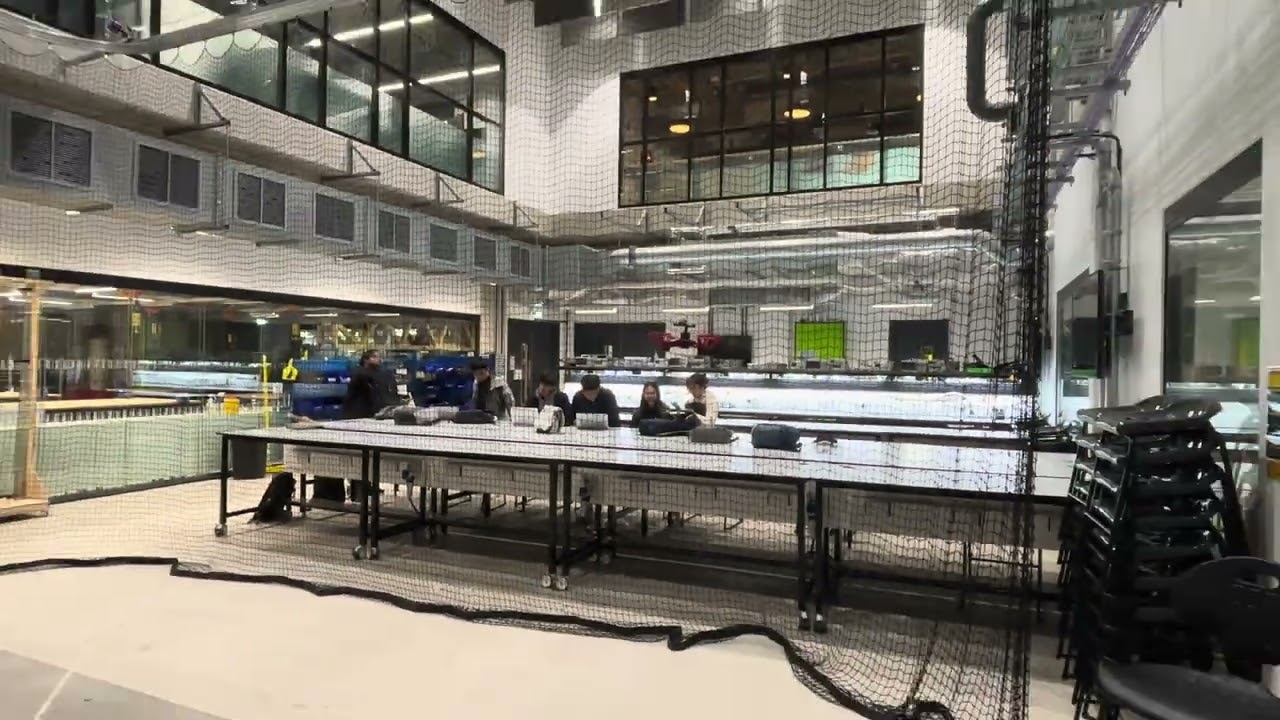
3:15Drone Week-1 trail
Initial drone feedback control session and flight testing.
 Live
LiveDrone Week-2 trail
UAV adaptive trajectory tracking and simulation demonstration.
 Live
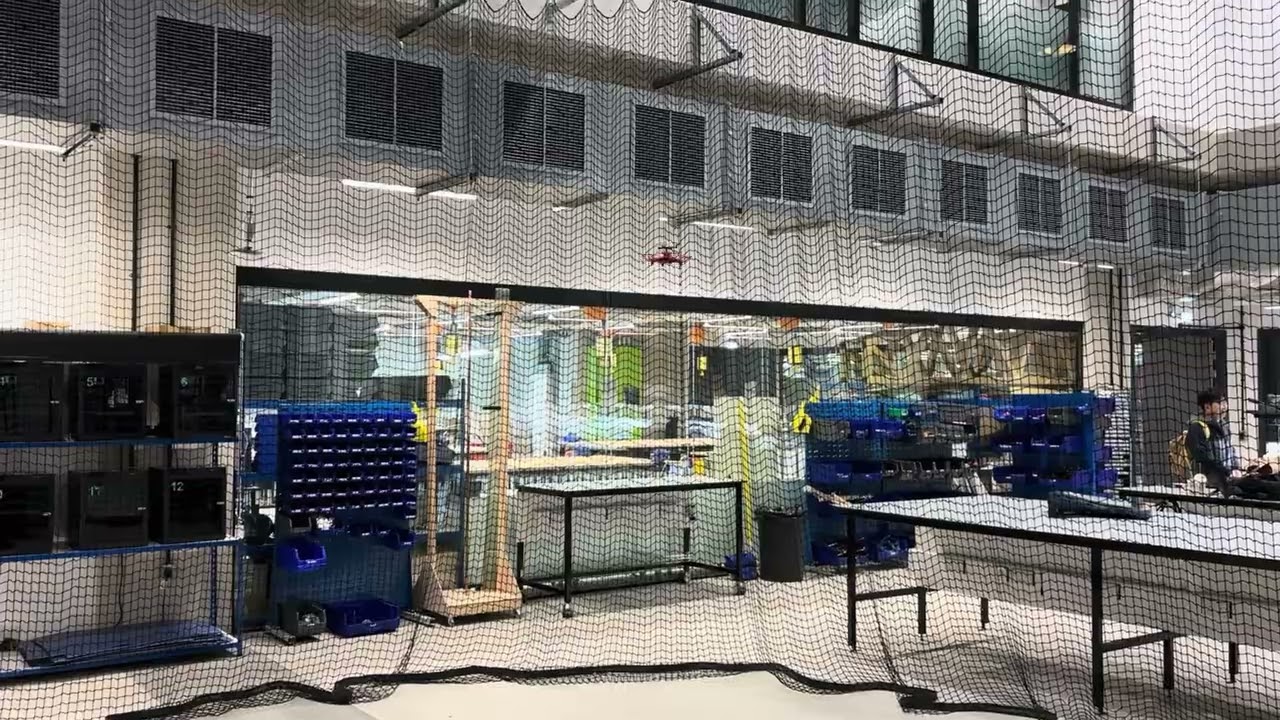
LiveDrone Week-3 trail
Trajectory tracking and stabilisation testing during week 3.
 Live
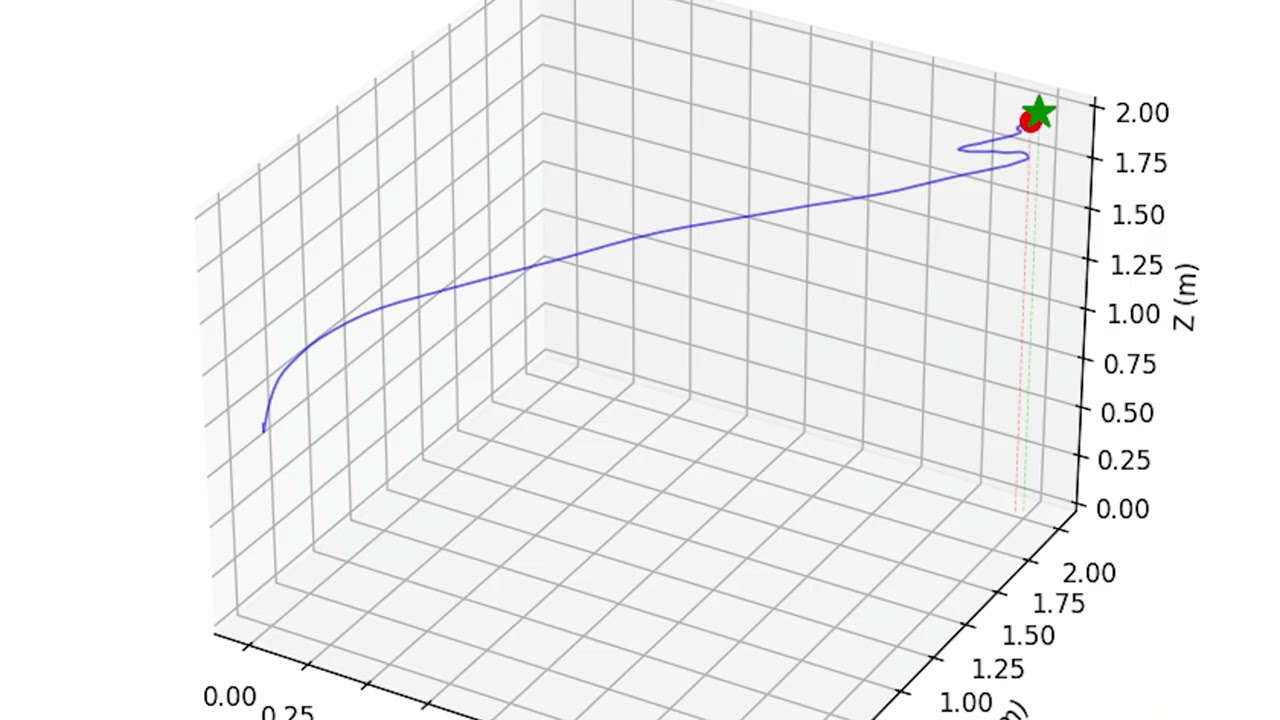
LiveTechnical Evaluvation
UAV adaptive position stabilisation and robust waypoint tracking tests.
GitHub
GitHub repositories for this project.
Drone Feedback Controller Repository
Access the complete source code on GitHub.